Tier 1
Documentary audit
$89 USD
Full remote document review. Reading the certificate, cross-checking the seller's identity, validating the cadastral number and document consistency.
Turnaround: Report within 72 h
The practical guide we wish someone had handed you before you signed. Written by a licensed architect, drawing from hundreds of files seen in Kinshasa.
By Espérant BASOLUA MABANZA, licensed architect (CNOA n°1054) · More than 1,700 projects supervised in Kinshasa and Lubumbashi (real estate, construction, architecture, surveys, GIS).
You're probably in Brussels, Paris, Montréal, or Houston. You've saved for years to invest back home. And you're afraid, rightly so, of losing everything to a piece of land that will never truly belong to you.
This guide isn't a course in Congolese land law. It's what I'd tell my brother or sister if they called me tomorrow and said: "I found a plot in Mont-Ngafula, they say it's a great deal, what do you think?".
I'm an architect registered with the National Order (CNOA n°1054). I've supervised more than 1,700 projects in Kinshasa and Lubumbashi, real estate, construction, architecture, surveys, and GIS. Over the years I've watched too many friends, clients, and relatives invest in plots that turned out to be contested. Almost every time, the problem could have been avoided, for a tiny fraction of the purchase price.
This guide distills the questions, checks, and traps that come up in 80% of the cases I see. Read it calmly. Print it if you can. And if afterwards you'd like us to look at your specific file, you know where to find me.
In the DRC, what a seller calls "the papers for the plot" can refer to four very different documents, and they don't carry the same legal weight. Here's the hierarchy, from strongest to weakest.
| Document | Strength | What it proves |
|---|---|---|
| Certificat d'enregistrement (Registration certificate) | ★★★★★ | The holder owns a perpetual or ordinary registered concession. This is the title you want. |
| State lease (Contrat de location) | ★★★★ | Temporary concession signed with the State. Solid, but time-limited. Check the expiry date. |
| Livret de logeur (occupancy booklet) | ★★ | Administrative document certifying occupation. It is not a title deed. |
| Customary attestation | ★ | Recognition of a customary right by a local chief. Not enough to build in an urban area. Since the N'Sele Act (n°25/062 of Dec 30, 2025), it must be issued by the customary chief and recorded by the State to be enforceable. Without both formalities, don't pay a cent. |
Ask the seller: "Is the certificate in your name, or in the name of someone you represent?". If the answer isn't instant and clear, raise an eyebrow. Three out of four buyers get trapped right here: the "seller" isn't the title-holder; they're reselling something they never owned.
Ask them by phone or WhatsApp, in this order. Write down the answers. A single hesitation on any one of them is your first red flag.
"Are you the owner or an agent acting for someone else?"
If they're an agent, ask to see the power of attorney. Without it, go no further.
"What is the registration-certificate number?"
A real owner knows it by heart or pulls it up in two minutes. A broker without a title stalls.
"Which registry is the plot recorded in?"
The answer pinpoints the competent Conservator's office. That's where the check will happen, nowhere else.
"Are there any easements, disputes, or pending claims?"
If they say no, get it in writing in the promise of sale. If they refuse, you now know how things really stand.
"Can you send me the plot plan and the cadastral sheet?"
These are the documents a surveyor needs to locate the plot on the ground and on a map.
"Who currently occupies the plot?"
Seller's family, tenant, illegal occupant, encroaching neighbor: each scenario has its own cost and resolution timeline.
"Do you accept an independent verification before signing?"
An honest seller answers "of course". A seller with something to hide finds a reason to refuse, or insists on a deposit before the verification. No reason holds up. None.
Reading break
Got a plot in mind?
Documentary audit at $89, report within 72 h.
These signals come from real files that have crossed my desk. None are innocent. Three or more present at the same time: walk away, no matter how "good" the price looks.
Red flag 1
A 500 m² plot in Lemba at $20,000 when the market is at $130,000? Either the title is fake, there's a dispute, or it's a non-buildable zone. A low price is never free.
Red flag 2
“Just send $500 to reserve the plot.” That deposit is the scam's paycheck. You'll never see the money or the plot again.
Red flag 3
The “owner” passed you to a “cousin,” who passed you to a “fake registry agent,” who works with a “land engineer.” The longer the chain, the higher the risk of scam or double sale.
Red flag 4
Every legally registered plot has a cadastral number. If the seller can't give you one, or the number doesn't match anything in the registries, the answer is no.
Red flag 5
With QGIS and a recent satellite image, you can confirm in 10 minutes whether the photographed plot matches the advertised address. In 1 out of 7 files, it doesn't.
Red flag 6
The magic phrase that often means: the title doesn't exist yet, or is contested. Regularization can take 3 months or 12 years. Never buy on a promise of regularization unless the price honestly reflects the risk.
Red flag 7
No boundary stones, no fence, no trees on the edge, no shared wall? You're buying a plot whose contours only exist on paper.
Red flag 8
Every serious land sale in the DRC closes at the Land Titles Registry, where the Conservator of Land Titles registers the transfer deed. A seller pushing for a private signing at home is in fact offering you a deed that's worth nothing.
Red flag 9
Be suspicious: either the previous buyer discovered a problem, or the same plot has been sold to several people in cascade. Ask to see the seller's own deed of purchase.
Red flag 10
“Decide today or I sell to another buyer.” Pressure is the fraudster's weapon. An honest seller gives you 7 days to do your checks.
Tick each flag you spot. Three ticks: stop the transaction and call a professional.
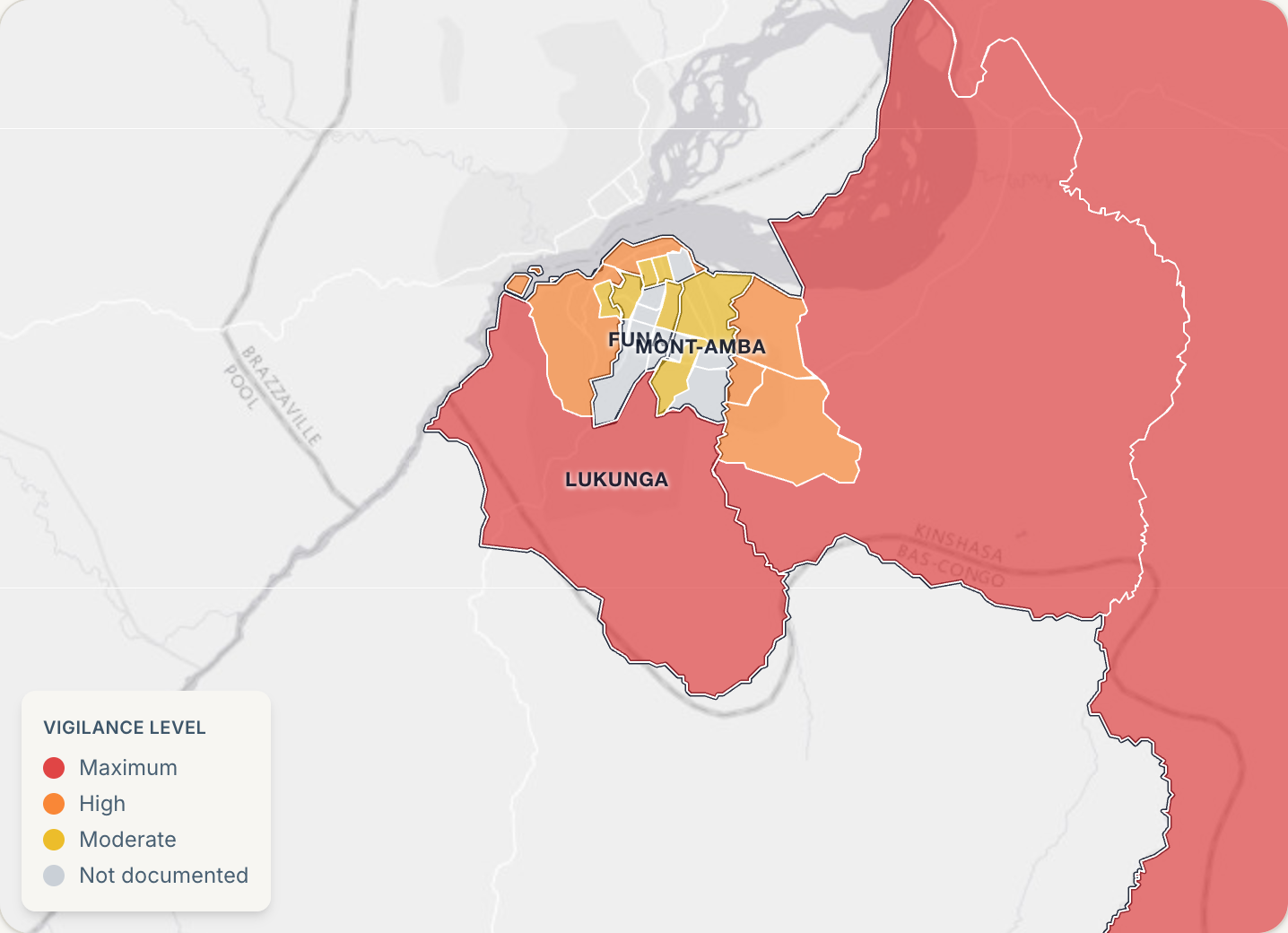
In Kinshasa, the commune where a plot sits dramatically changes its risk profile. Here's the quick read we apply to every file in 2026. The 24 communes fall into 4 districts (Lukunga, Funa, Mont-Amba, Tshangu); the map below breaks them down one by one.
| Commune | Price range | Dominant risk |
|---|---|---|
| Gombe | $500K – $15M | Title conflicts, parcels occupied by government bodies. |
| Barumbu | $60K – $1.5M | Central business district. Long-standing occupations without regularised title, heavy pressure from property developers. |
| Upper Ngaliema: Ma Campagne, GB, upper UPN | $200K – $1.6M | Poorly documented easements, outdated cadastral maps. |
| Mid Ngaliema: Binza, Mimosas | $50K – $500K | Double sales, unsettled inheritance chains. |
| Lemba: Salongo, Super, Terminus | $130K – $400K | Boundary encroachments, contested neighbors. |
| Limete: Industrial, Funa, Bobozo, first streets | $100K – $900K | Commercial vs residential zoning, special permits required. Prices vary widely from one neighborhood to the next. |
| Mont-Ngafula | $30K – $650K | Very high variability, flood zones, unstable slopes, active customary chiefs (incoming-chief disputes common). |
| Kintambo | $150K – $900K | Dense urban fabric, frequent right-of-way easements. Among the highest price per m² outside Gombe: a low asking price is a warning sign. |
| Bandalungwa | $85K – $350K | Dense urban fabric, frequent right-of-way easements. |
| Kalamu | $80K – $250K | Dense urban fabric, frequent right-of-way easements. |
| Kasa-Vubu | $190K – $600K | Former planned township. Right-of-way easements, encroachments. Among the highest price per m² in the Funa district. |
| Ngiri-Ngiri | $100K – $490K | Former planned township, dense fabric. Plots often already built on, boundary encroachments. |
| Bumbu | $70K – $170K | Dense working-class township. Small plots, frequent right-of-way easements. |
| Selembao, Kisenso | Sample too small | Erodible slopes and non-aedificandi zones. A valid title does not protect against administrative demolition. |
| N'sele, Maluku | $15K – $100K | Outskirts, customary titles vs concessions, weak utilities access, frequent unsettled successions. |
| Mitendi and outer subdivisions | $5K – $15K | Informal subdivisions, unregistered plats, difficult recourse, multiple customary sales on the same parcel. |
Ranges recalibrated in July 2026 against public listings of vacant plots in Kinshasa. These are sellers' asking prices, not transaction prices.
Beyond the title, there's a layer of technical analysis most buyers skip. These traps don't show up in the documents, they only appear when you start building. By then it's too late.
Buying a plot from abroad means verifying three very different things: the title, the land, and what you can build on it. Doing all three yourself, or entrusting them to a single intermediary, almost always misses one angle. Three professionals, each on their own craft, drive the risk down for good.
You're at the finish line: title verified, plot measured, price negotiated. The signing remains. This is where many buyers lose everything they secured over weeks of work.
Mistake 1
A private contract is legally weak. The only deed that truly protects the buyer is the transfer deed registered by the Conservator of Land Titles, then recorded at the cadastre. Cost: 1 to 3% of the price. An illusory saving if you skip it.
Mistake 2
Full payment must happen after the actual mutation at the cadastre, or at the signing of the transfer deed at the Land Titles Registry that triggers it. Wiring 100% before ownership has been transferred to your name is a voluntary undressing.
Mistake 3
You're in France, asking your cousin to sign for you? They need a special, legalized power of attorney, at the embassy or before a recognized authority, stating the exact scope (plot number, maximum price, conditions). A verbal mandate only binds you, and betrays you the moment it's misused.
Mistake 4
Is the person you see signing actually the certificate holder? The ID presented on signing day must exactly match the name on the certificate. A namesake, a typo, a missing letter, any of those can void the deed.
Mistake 5
An unrecorded sale is unenforceable against anyone. Until the transfer is entered in the register, the seller can technically resell the same plot to someone else. Don't leave Kinshasa without the registration certificate in your name.
Mistake 6
Before the reform, some buyers reassured themselves that long peaceful occupation would consolidate their right. The N'Sele Act of December 30, 2025 (n°25/062) abolished adverse possession in land matters: long occupation does not replace a regularly registered right. The national registry and digital cadastral plan are statutory goals under gradual deployment, not an operational title blockchain. If someone offers you a plot "occupied for 40 years, we'll regularize later," it is a major risk.
Print it and tick boxes as you go. Don't pay a single deposit until the first 12 boxes are ticked.
Generally 6 to 12 weeks. Plan 2 to 3 weeks for the documentary and on-site verification, 3 to 4 weeks for negotiation and the promise of sale, and 2 to 3 weeks for the signing of the transfer deed at the Land Titles Registry and registration. Trying to go faster means skipping a step, and paying the bill later.
Yes, provided you have a legalized power of attorney and a trustworthy agent. Many of our diaspora clients fly down only once, sometimes never before signing. The co-signed report, geolocated photos and a live video tour replace your physical presence.
Beyond the asking price, budget: registration and transfer fees (1 to 3% of the price), cadastral registration (variable), broker commission if applicable (3 to 5%), an independent audit ($89 to $399), and contingencies for unexpected admin. On average, 5 to 8% of the purchase price in ancillary costs.
A transfer executed in authentic form and registered by the Land Titles Registrar gives you solid legal recourse. But those recourses take time (often several years in the DRC). Which is precisely why a pre-purchase verification costs 50× less than post-purchase litigation.
Three things. One: we're not solely lawyers, our team pairs a lawyer with a surveyor and an architect. Two: we work at a fixed, announced price, not by the hour. Three: our only revenue is the audit you pay for. No hidden commissions on the transaction, no ties to sellers.
For an ongoing or upcoming purchase: yes, essential. The Loando Act (July 2025) requires a spatial-conformity opinion for projects and programs with a spatial impact, including the real-estate project plans concerned. The N'Sele Act (December 2025) abolishes adverse possession and protects local communities' land rights. For a purchase already properly registered, the title remains valid, but its consistency with the registries, the land and planning rules should be checked before a new project.
The N'Sele Act provides for a national land-and-property rights registry, a digital georeferenced cadastral plan and a unique cadastral identifier. Deployment is gradual: in August 2026, the Ministry still described archive sorting and encoding as a first phase, with pilot sites. Check which records actually exist in the competent district instead of assuming a complete digital registry is available nationwide.
For fifty years, Congolese land law turned on two founding texts: the 1973 land law (regime of property) and the 1957 colonial decree (urban planning). Between 2018 and 2026, the Congolese State undertook the largest overhaul of this edifice since independence. Three texts deserve to be known by name.
Before you buy, you need to know which zoning your plot falls under. Here are the tools to know, from the most strategic to the most local:
| Tool | Level | What it changes for you |
|---|---|---|
| PNAT | National (2050 horizon) | Strategic framework. Sets the broad orientations (corridors, urban armature). |
| SNAT | National (~30 years) | Reference for all sectoral policies. Finalization announced for 2024-2025. |
| SPAT | Province | Planning rules at provincial scale. SPAT Kinshasa is in drafting. |
| SOSAK | Kinshasa agglomeration (2014, approved 2015) | Orientation scheme for Kinshasa, 2030 horizon, delivered in August 2014 and approved by provincial edict No. 004/2015 of 11 August 2015. Exists on paper, barely implemented. Consult it to check the theoretical zoning of your area. |
| PPA | Neighborhood | Particular planning plan, specific zoning and building rules. Mandatory and enforceable. |
| PSAT | Grouping / village | Rural variant, applicable outside cities. |
Beyond the title, certain zones are legally non-buildable or extremely high-risk. To check before any payment:
The Loando Act gives the inspectors of the National Territorial Planning Observatory (ONAT) the rank of judicial police officer with restricted jurisdiction. Practically: they can investigate, issue official reports, and trigger criminal proceedings for non-conformity. Specific sanctions and the scale are to be set by implementing orders currently being drafted. Our recommendation: don't build betting on the old tolerance, it is legally over.
Note: implementation remains progressive. The National Land-Use Council was organized by Decree n°26/09 of March 30, 2026 and a new interministerial easements order was signed on June 8, 2026. Other implementing measures must still be checked as published.
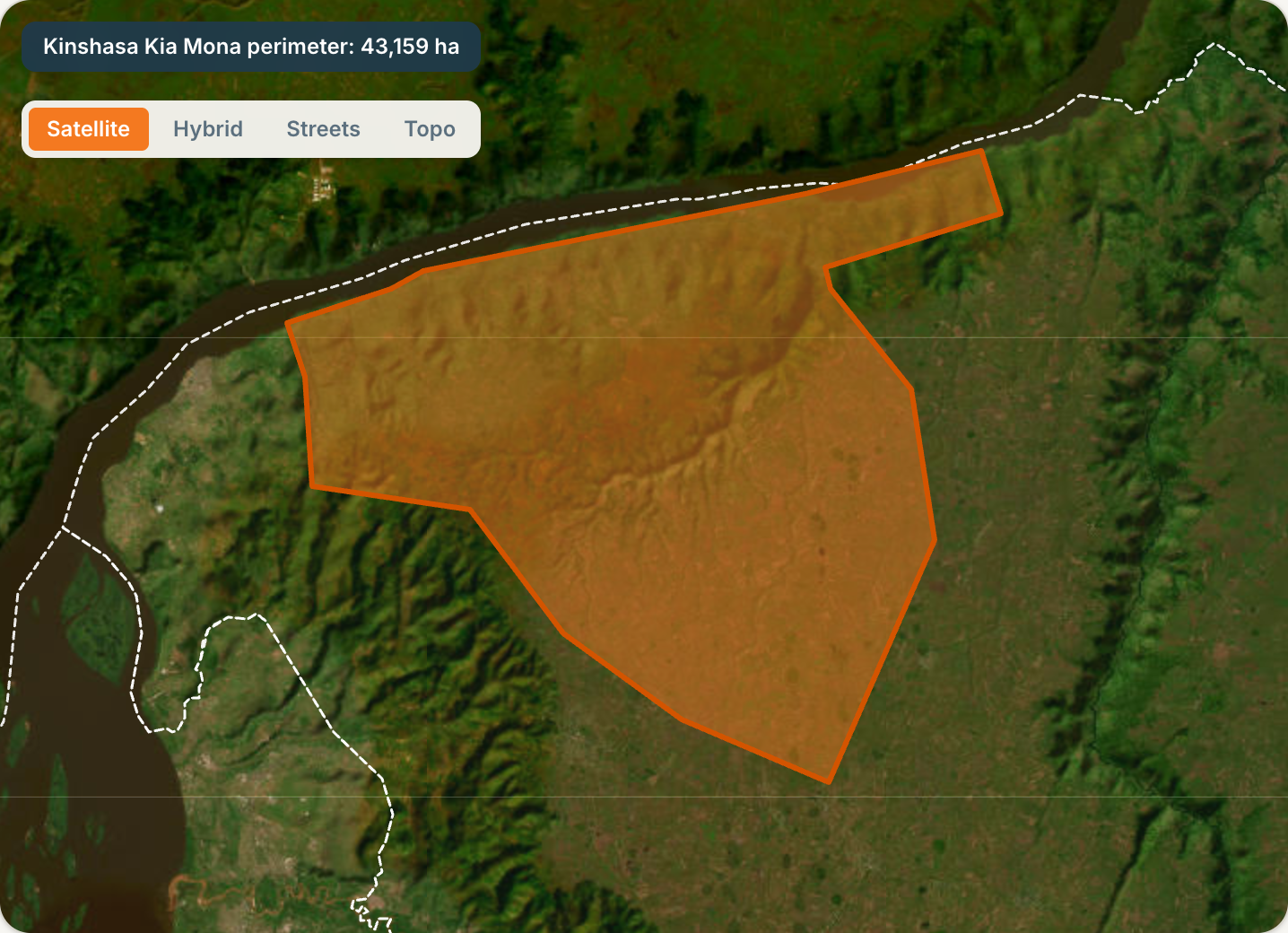
On April 20, 2026, the Minister of Land Affairs signed the Ministerial Order n°116/CAB/MIN/AFF.FONC/ONM/jna/2026 declaring of public utility a perimeter of 43,159 ha 90 ares in Maluku commune, designated to host the extension of the City of Kinshasa named "Kinshasa Kia Mona". It is the most ambitious land operation ever launched in Kinshasa.
Here is what the perimeter looks like, traced from the 17 GPS points published in the order:
Many buyers, especially in the diaspora, keep getting offers for plots in Maluku "at unbeatable prices". Some of those parcels already sit inside the public-utility perimeter. Buying today without checking means buying a file that will, at best, be reduced to whatever indemnity the State sets, and at worst be voided outright.
It's precisely for this kind of case that our audits now include a systematic cross-check of the plot's GPS coordinates against every public-utility perimeter in force (ministerial orders, expropriation declarations, neighborhood plans).
Public sources: Ministerial Order n°116/CAB/MIN/AFF.FONC of April 20, 2026 (signed O'Neige N'Sele Mimpa, Minister of Land Affairs); Decree n°23/35 of October 10, 2023 creating the CSSPEVK (amended by Decree n°26/010 of March 30, 2026); official communications from the Strategic Committee for the Supervision of the Kinshasa Extension Project (csspevk.cd).
Kia Mona isn't an isolated case. The south-east and south-west ring roads of Kinshasa have already displaced hundreds of families. The Maluku SEZ indemnified 99% of its occupants before handover. Other operations are being prepared: servicing of the capital's extensions, future special economic zones, public-works projects announced in national programs. Sooner or later, any landowner can receive a letter saying their plot has been "declared of public utility." This chapter explains what happens next, and what you can do.
Law 77-001 stacks short deadlines. As long as you meet them, you stay inside the procedure. If the administration misses them, you gain leverage.
| Step | Deadline | Reference |
|---|---|---|
| Your claims, observations, counter-offer | 1 month after receipt | art. 11 |
| Time between summons and hearing | 15 days | art. 14 |
| Court rules on regularity + appoints 3 experts | 8 days after the hearing | art. 14 |
| Filing of the expert report | 60 days (+30 max) | art. 15 |
| Judgment setting the indemnity | 1 month after the hearing | art. 17 |
| Actual payment of the indemnity | 4 months max | art. 18 |
From the most accessible (no lawyer needed) to the most technical (lawyer essential):
Administrative grievance
Reasoned letter to the issuing authority within the one-month window. Include your observations, contest the public utility, propose a quantified indemnity. It's the first step, rarely decisive on its own, but it locks your file for what follows.
Challenge to procedural regularity (art. 24)
Every formality is prescribed on pain of nullity. Missing signature, missing or non-conforming plan, no Gazette publication, faulty notice, shortened deadlines: each defect is grounds for nullity. Often the most accessible lever when the administration has sloppy paperwork.
Challenge to the indemnity amount
The most common litigation. You submit a private contradictory appraisal (registered surveyor-appraiser or certified evaluator), with recent comparables, the value of improvements, lost activity, and use value. The court can rely on it, weighing it against the cadastral experts' report.
4-month annulment action (art. 18)
Filed if the State hasn't paid within 4 months of the judgment. Often forgotten by the expropriated parties themselves. The mechanism that rebalances the procedure when the administration drags its feet.
Annulment before the Council of State
For excess of power, misuse of power, or sham public utility. To file in parallel with the judicial proceedings if the order itself seems unlawful on the merits. Lawyer recommended.
Right of repurchase (art. 21)
If the State ultimately doesn't put your property to the declared use, it must publish a notice in the Official Gazette. You then have 3 months to declare your intent to buy it back. Repurchase-price ceiling: the initial indemnity + 6% per year elapsed. Failing such a notice, you can apply directly to the court. This mechanism is almost never invoked, even though it's written in plain text in the law.
When the State values your plot, it leans on the official mercurial (a zone-based scale). The scale is convenient for the administration; it is almost always below true market value, especially in peripheral communes where prices have exploded in five years. The N'Sele Act introduces a modernized mercurial, but the structural gap will persist.
The Constitution requires a fair indemnity, so the debate is open. In practice: have a contradictory quantified appraisal drawn up by an independent professional, integrating recent comparables (neighboring sales), the value of constructions and plantations, lost economic activity, and relocation costs. The report goes into the judicial file and carries weight against the cadastral experts.
Verify the formal validity of the act
Ministerial signature (or presidential ordinance for major works), date, attached plan, precise identification of your plot, confirmed Gazette publication, regular individual notice. The smallest defect is a card you'll keep for the judicial phase.
Gather evidence of your right and your improvements
Registration certificate (the strong title), authentic deed, evidence of customary land rights or local-community use, SNEL/REGIDESO bills, dated photos, certification from the neighborhood chief, construction invoices. Law 77-001 indemnifies real rights AND improvements, you must prove both.
Prepare a quantified counter-offer
Independent appraisal, comparables, lost activity, relocation. Even imperfect, it forces the administration to step out of the scale-only logic.
Send a reasoned recorded-delivery letter before day 30
To the issuing authority, acknowledging receipt of the act, stating your claims, and attaching your counter-offer. Keep the proof of delivery. The letter counts as proof of observations in the procedure.
We inform (this chapter, the guide, the observatory articles). We verify upfront that a plot you're about to buy doesn't fall inside an existing public-utility perimeter: our AVANCE and EXPERT audits now cross-check the plot's GPS coordinates against the ministerial public-utility orders in force. We document the improvements on site (geolocated photos, surveys), useful evidence if an expropriation comes later.
We are not lawyers. For pleading before the court or the Council of State, we refer to the Kinshasa Bar (Gombe or Matete, depending on jurisdiction). We are not certified surveyor-appraisers; for a quantified contradictory appraisal, we refer to a recognized real-estate expert.
Sources: Constitution of February 18, 2006 (revised January 20, 2011), Article 34; Law n°77-001 of February 22, 1977 on the procedure of expropriation for public utility (Articles 1, 5-8, 11-21, 24); Land Law n°73-021 of July 20, 1973 as amended and supplemented by the N'Sele Act n°25/062 of December 30, 2025; Loando Act n°25/045 of July 1, 2025 on territorial planning.
If after reading the guide you've identified a plot that looks serious, the natural next step is to have it audited by a neutral eye. Three packages.
Tier 1
$89 USD
Full remote document review. Reading the certificate, cross-checking the seller's identity, validating the cadastral number and document consistency.
Turnaround: Report within 72 h
Tier 2
$219 USD
Everything above + on-site visit + topographic survey + precise georeferencing + dated photos.
Turnaround: 5 working days
Tier 3
$399 USD
Everything above + administrative cross-check and registry pull at the Conservation des Titres Immobiliers, full legal file.
Turnaround: 10 working days
Best of luck with your project.
Espérant BASOLUA MABANZA
Licensed architect, CNOA n°1054 · For the Parcelle Safe Kin team.
We'll write once to send you the link. You can print it as PDF in one click, or just reopen it when you're staring at a specific file.